

The quality system and quality assurance work in education at Nord University are anchored in the applicable legislation for educational activities.
- The Universities and University Colleges Act (norwegian)
- Regulations relating to the Universities and University Colleges Act § 1-7 – Requirements for a Quality System (norwegian)
- Regulations relating to the Universities and University Colleges Act § 1-8 – Requirements for Quality Assurance Work (norwegian)
- Regulations on Studies and Examinations at Nord University (norwegian)
As a student, you are the most important contributor to the quality assurance work at Nord University.
To ensure high-quality study programs, the university relies on the active participation of students—whether through feedback on the content of the studies, the way teaching is conducted, or the social and physical framework surrounding the studies.On a dedicated website, the university has gathered information about where students participate and have influence in the quality work, which channels they can use to provide feedback, and where they can find information about the results of the systematic quality assurance efforts.
Educational Quality – Student Participation
The model was adopted by Nord University in Board Case 14/25 on March 6, 2025.
The model is based on the Universities and University Colleges Act, the Regulations relating to the Act, and the Regulations on Studies and Examinations at Nord University. Sections §§ 1-6, 1-7, and 1-8 of the Regulations describe the requirements for a quality system and for quality assurance work.The Model for the Quality System and Quality Assurance in Education provides an overall view of the components involved in quality work and their interaction. The model is twofold and consists of ongoing and periodic quality assurance processes.
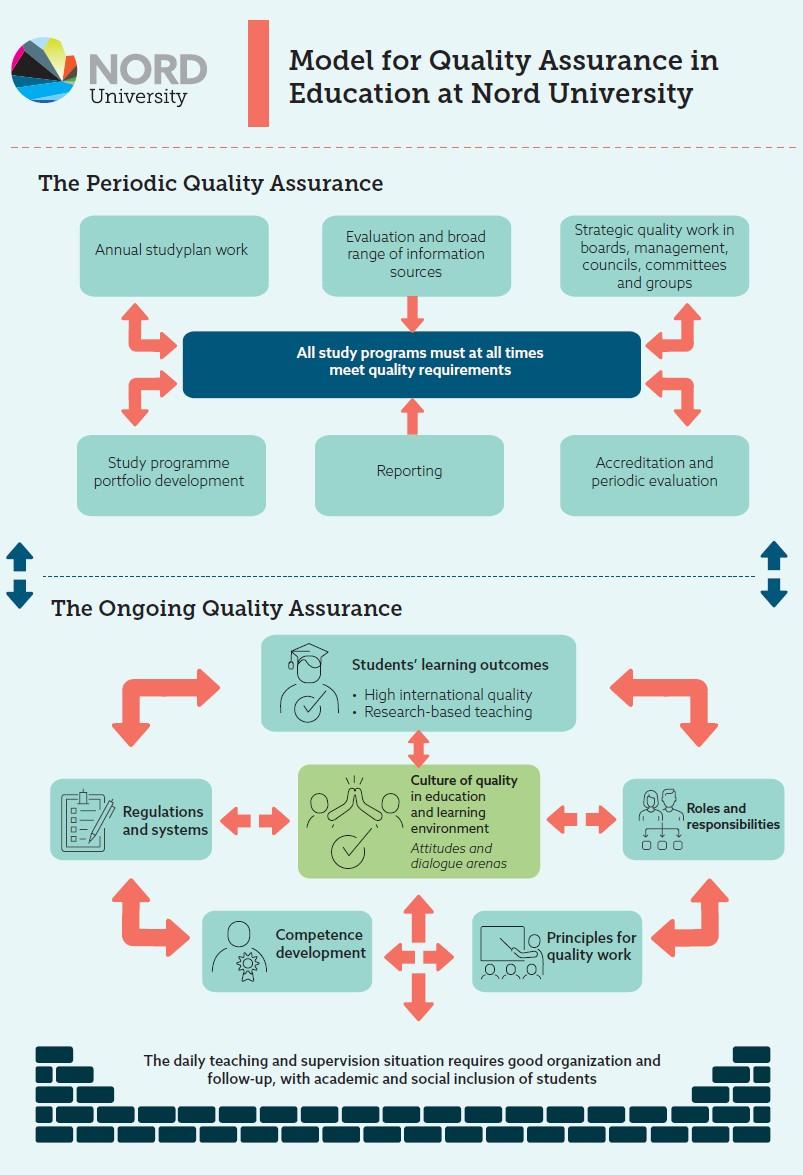
Systematic Quality Work in Higher Education
Guidance on Requirements for Quality Systems and Quality Work in the Universities and University Colleges Regulations, NOKUT 2025Adopted by Nord University in Board Decision 14/25 on March 6, 2025
Evaluation and Reporting
Teachers shall regularly evaluate their teaching, engage in dialogue with students and colleagues, initiate improvements, and assess the effects of implemented measures. This shall be reported in accordance with the reporting lines.
Culture of Sharing
Students and staff are expected to contribute to a culture of sharing and participate in relevant dialogue arenas concerning educational quality and the learning environment.
Risk Management
Staff shall help identify risks that may affect students’ learning outcomes and contribute to the development of measures to minimize these risks. This ensures a safe and stimulating learning environment and helps ensure that study programs meet all requirements at all times.
Roles and Responsibilities
Staff shall take a holistic approach to quality work and are therefore expected to coordinate and seek clarification when there is uncertainty about further follow-up and responsibility for quality and quality deficiencies.
Development and Participation
Students and staff shall play an active role in the evaluation and further development of study programs. Representatives from working life and society, as well as external academic peers, shall contribute with insight and experience, including to ensure that study programs are relevant to the needs of working life and society. Development initiatives shall be based on a cost-benefit assessment.
Adopted by Nord University in Board Decision 14/25 on March 6, 2025
Students and staff shall participate in quality assurance work. In addition, students, as well as representatives from working life, society, and relevant external academic peers, shall contribute to the periodic evaluation of study programs.
Reporting lines within the educational activities shall promote transparency, participation, and development. Deficiencies in quality shall be identified so that necessary measures can be implemented.
When the Board adopted Strategy 2030 (case 126/20), it was simultaneously decided that the overarching strategy would form the basis for the faculties’ and departments’ sub-strategies and action plans.
The Board later adopted the Action Plan for Education 2021–2025 (case 92/21). This plan has since been revised by the Education Committee.Download the current Action Plan for Education (norwegian)
Roles and Responsibilities
The roles relate to the Education area. Persons assigned to these roles may also have other duties. If the faculty has a supplementary role description, it is important to ensure that there is no break in the chain of responsibility.
For PhD programmes, see doctoral degrees page for more detailed information.
- bears the overall responsibility for the quality system and systematic quality work within the Education area
- is responsible for ensuring that priorities and decisions support the development of the study portfolio
- bears the overall responsibility for ensuring that the learning environment at the institution is fit for purpose, based on a general assessment of concern for the students' health, safety and welfare
- should take an active part in the councils and committees where student democracy is represented
- should participate in evaluations and make suggestions for improvement, and thereby help to develop the quality culture
- is responsible for actively participating in the learning processes
- is responsible for reporting any matters that impede their learning and academic development
- ensures that priorities and general conditions contribute to a good learning environment and good quality in the courses
- bears the responsibility, on behalf of the Board, for ensuring that the systematic quality work meets internal and external requirements
- is responsible for ensuring that the quality work is supported by the Board and management of the institution at all levels
- is responsible for final approval of study plans, accreditation and periodic evaluation of courses worth over ECTS 30 credits
- reports to the Board through the annual quality report for Education
- is responsible for ensuring that systematic quality work is carried out within the Education area in accordance with the applicable regulations
- is responsible for further developing the systematic quality work and helping to promote a quality culture
- is responsible for maintaining an effective system of accreditation and periodic evaluation of study programmes
- chairs the central Education Committee
- chairs the International Committee
- acts as chair/deputy chair of the Learning Environment Committee
- bears the overall responsibility for the systematic quality work and helps to promote a quality culture in the faculty
- ensures that the students have an appropriate learning environment
- is responsible for resource allocation and the quality of the courses
- is responsible for ensuring that the courses are covered by academic staff in line with the regulations
- is responsible for ensuring good preparation in the faculty’s work on accreditation
- is responsible for approval of study plans, and accreditation and periodic evaluation of courses worth 30 ECTS credits or less, and the associated documentation
- reports to the Rector each year through the faculty’s report on educational quality
is responsible, on behalf of the Dean, for:
- chairing the faculty education committee
- ensuring and documenting that the faculty’s study portfolio meets the requirements in the applicable regulations, including accreditation and periodic evaluation of the courses
- implementing quality-improvement measures and following up on these, driving the systematic quality work and helping to further develop the quality culture
- facilitates quality work and helps to further develop the quality culture
- is responsible for facilitating research activities and academic development and ensuring that the teaching is research-based
- is responsible for competency development
- is responsible, together with the faculty management, for ensuring that the courses have the necessary resources available
- is responsible for ensuring that risk assessments and risk reduction measures are carried out in teaching situations with possible increased risk
The responsibilities of the Academic Division Head are defined in more detail within each faculty.
The SPH provides academic and pedagogical leadership for the courses, and is responsible for planning, delivering, evaluating and developing the courses in line with requirements in the applicable regulations. This means that he/she:
- is responsible for ensuring that the courses have/share a study programme council, and chairs the study programme council where appropriate.
- participates in forums for quality development of courses and the study programme itself
- assesses whether the courses meet competence standards based on requirements in regulations, and reports any needs to the faculty management
- where courses are offered at several study locations, helps to ensure that the students receive the same quality of teaching
- works with the teaching staff and the study programme council to develop academic content, profile and relevance, a programme design with a good connection between courses, and consistency between the learning outcome and the forms of learning and assessment.
- helps to ensure to the learning activities are research-based.
- is responsible, together with the Vice–Dean for Education, for ensuring that the courses are of high international quality and are an effective gateway to mobility
- conducts an annual study programme evaluation based on relevant information, to support improvement and development
- is responsible for ensuring that there has been an evaulation of safety in teaching situations as specified in the study and course plans, at the time of accreditation and periodic evaluation of the study programme and in the annual audit of the study plan
- holds regular meetings with student representatives and other students on improving the quality of the courses and the learning environment
- provides documentation of the quality work on the courses and prepares an annual report for the local education committee
- provides for an annual review of the study plan, and ensures that details of the courses on websites are up-to-date and relevant
- assists in planning and organising the start and end of studies, makes contact with collaboration partners and assists in student recruitment
- driving the systematic quality work and helping to further develop the quality culture
The Study Programme Coordinator has responsibilities delegated from the Study Programme Head where the course runs at multiple study locations - but the scope of these tasks will vary between programmes and faculties. The following tasks are normally assigned to the SPC:
- coordination and operation of the course at the study location on behalf of the HSP
- regular meetings, in collaboration with the SPH, with student representatives and other students on improving the quality of the course and the learning environment
- following up on student concerns when needed
- assistance in planning and organising the start and end of studies, make contact with collaboration partners and assist in student recruitment
- driving the systematic quality work and helping to further develop the quality culture
There should only be one course coordinator per subject. The course coordinator is responsible for planning, delivering, evaluating and developing the course, to ensure consistency between the learning outcome description, the teaching, and the forms of learning and assessment. The course coordinator will generally teach the course. This means that he/she:
- develops the course specification/plan and revises it each year, and ensures that information on the course is up-to-date and relevant
- is responsible for registering the syllabus.
- ensures that the LMS area (Canvas) contains up-to-date and relevant information.
- helps to ensure that the students receive the same quality of teaching where the course is offered at multiple study locations
- contributes to and follows up on evaluations of the course and implements quality-improvement measures together with the HSP.
- ensures that risk assessments are carried out and implements risk-reduction measures in teaching situations with possible high risk
- provides input to the faculty on current examiners and contacts the examiner(s) to ensure that papers are marked within the deadline
- ensures that exam questions and associated mark schemes are prepared within the deadline, and that the mark schemes are made available to the students by the time the papers are marked
- ensures that other necessary deadlines are also adhered to
- works with the students to create a good learning environment and maintains good quality on the course
- works with the course coordinator to provide teaching and learning activities that help the students to achieve the learning outcomes for the course
- has regular discussions with the course coordinator and students on the quality of the course
- participates in forums for quality development of the course and the course content
- participates in the systematic quality improvement work and helps to develop the quality culture.
The year group representative plays an active role in ensuring that the students’ have a say in how their courses are run. Key tasks are:
- Attend meetings with the university on quality improvement in relation to evaluations (course evaluation, study programme evaluation, the Norwegian National Student Survey, SHoT etc.)
- Act as a link between the class and the lecturer.
- Act as a link between the class and the study programme head/course coordinator.
All students have a responsibility to contribute to a good student environment. It is not the job of the year group representative to be a driver for social measures aimed at the students.
- ensures that educational activities meet the requirements for the quality system and quality work
- works with the faculty management to enhance interaction and workflow in the quality work
- facilitates the implementation of the systematic quality work and helps to further develop the quality culture
- assists in planning and organising admissions to the course
- assists in planning and organising exams, assessments and diploma certificates
- helps to promote digital teaching tools and solutions
- helps to promote internationalisation and mobility
- contributes to quality assurance and availability of the syllabus
- contributes relevant course materials to students and staff
- assists in obtaining background literature
- ensures that student dissertations are filed in a public archive (National Science Archive) in line with the applicable regulations
- provides guidance on IT skills and academic writing
- provides a physical and digital learning environment for students
- assists in developing the literature portfolio for a new course
- contributes to systematic quality work and helps to further develop the quality culture
- facilitates the implementation and development of the systematic quality work in the faculty
- contributes to cooperation and interaction between the faculty and the Education department in the work on educational quality
- helps to develop good work processes and assists in the running the annual cycle for the academic work
The role description sets out the tasks of someone assigned to a company to follow up a student on placement. The tasks of a placement supervisor will be laid down in the contract between Nord University and the placement provider, and will include:
- providing guidance and learning activities that help the students to achieve the learning outcome for the placement
- assisting in the evaluation and assessment of students on placement where these follow from the design of the placement
- having ongoing discussions with the students, the course coordinator and the faculty administration on the quality of the placement
As an addition to the regular teaching, outsiders may contribute up-to-date knowledge from various fields of study and research, and relevant knowledge and expertise from society and businessess
- is an advisory body for the university management in all matters relating to education and quality of teaching, and ensures that the quality is maintained and developed in a comprehensive and satisfactory manner in the institution
- ensures that the systematic quality work in the institution and the internal system for quality assurance are followed up and further developed in a satisfactory manner
- contributes to knowledge-sharing, development and learning
- adopts, implements, evaluates and follows up processes and measures related to educational quality within the University’s priority areas and policies provided by the Board/Rector
- advises the Rector on matters relating to common guidelines within the area of education, accreditation of new courses, etc.
- is quorate when more than half of the members are present (including deputies where permanent members cannot attend)
- takes an active part in planning the university’s work on the development of an inclusive, diverse and universal learning environment (advocate and influencer role)
- helps to ensure that the Board, in collaboration with the Student Union, provides a good study environment and improves student welfare on all campuses
- is involved in all high-level surveys and evaluations relating to the students’ overall learning environment.
The International Committee at Nord University has an important role in stimulating internationalisation activities in the faculty and among students, and in building a strong culture for internationalisation within the institution.
1. The International Committee is an advisory board for Nord University’s management in all matters concerning internationalisation in education and research.
2. The International Committee supports implemented, ongoing and future activities within the institution which contribute to increased quality in education and research through internationalisation.
3. The International Committee advises Nord University’s management on the allocation of strategic funding for internationalisation and follow up on the use of strategic funding at the faculty level.
4. The International Committee follows up on Nord University’s involvement in and contribution to the SEA-EU alliance.
5. The International Committee is quorate when at least half of the constituted members/deputy members are present
There should be a first semester committee at each study location. The purpose of the committee is to coordinate and share experience at the local level and provide input to the central committee. There may be local variations in size, composition and organisation. The first semester committee should work to ensure that all students at Nord University get off to a good start, with a warm welcome, integration and socialisation. The committee should work to look after all students, but with a special focus on the first-year students.
- is a driver behind for the study quality work in the faculty
- acts as the faculty’s operational tool in quality assurance and control of teaching activities
- works to maintain and develop good quality in admissions, general conditions, programmes and results
General mandate and guidelines for local education committees (pdf)
The Study Programme Council is an advisory body to the local education committee in matters relating to the courses, including quality, academic and pedagogical profile, content and delivery.