


Programme description
Career opportunities
The program is organized with session-based teaching. Students can expect two to four in-person sessions per semester, depending on the number of courses included in the semester plan. In the second half of the program, students work on their master's thesis. During this period, no fixed physical meetings are scheduled, but individual follow-up is arranged in dialogue with the supervisor.
Students can expect a good variety of dialogue-based classroom teaching, group work, and individual study throughout the program. Between sessions, students work both independently and in groups with the curriculum, assignments, and course requirements.
Admission Requirements for the Master's Programme in Social Analysis
To be eligible for admission to the Master's programme in Social Analysis, applicants must meet three overarching requirements:
- Requirement for a bachelor's degree
- Requirement for research methodology
- Requirement for a minimum average grade of C in the admission basis
1. Requirement for a Bachelor's Degree
To qualify for admission, applicants must hold a bachelor's degree in social sciences comprising 180 ECTS credits, or an equivalent education of at least three years' duration.
2. Requirement for Research Methodology
Applicants must have prior knowledge of research methods in social sciences or historical methodology equivalent to 10 ECTS credits (for example, ME118S Introduction to Social Science Research Methods, ME123S Introduction to Qualitative and Quantitative Methods in Social Science, HI122S Historical Theory and Method, or equivalent).
Courses such as Ex.phil and Ex.fac are not accepted as social science methodology.
If the applicant believes the methodology requirement is met through other courses, this must be sufficiently documented by the application deadline. The applicant must upload course descriptions and reading lists in the application for the course(s) to be considered.
3. Requirement for a Minimum Average Grade of C
Applicants must have completed a group of courses totaling 80 ECTS credits in social sciences that form the basis for admission.
The grade requirement is a weighted average grade of C. For applicants with professional degrees, the average grade is calculated based on the entire bachelor's degree. For other applicants, the average is calculated based on the 80 ECTS credit group in social sciences.
Any grade improvements may be included in the calculation basis. Relevant additional education may also be included in the basis for calculating the average grade.
If there are more qualified applicants than available study places, applicants will be ranked based on the following criteria: A weighted average grade is calculated for the courses included in the admission basis (including any improvements). If an applicant has multiple admission bases, the one yielding the most favorable result will be used. Applicants with foreign education are assessed individually.
Otherwise, the ranking regulations of Nord University apply, see the Regulations on Studies and Examinations at Nord University, §4-4.
The structure of the master's degree in social analysis facilitates exchange in the fourth semester of the part-time program (mobility window). In this semester, all students choose a combination of optional courses, which will lower the threshold for traveling on foreign exchange.
The following educational institutions may be relevant for exchange:
University of Northern British Columbia (UNBC) - Canada
Wageningen University – Netherlands
University of Iceland – Island
Roskilde University (RUC) - Denmark
Knowledge
The candidate:
- possesses advanced knowledge of social science and interdisciplinary approaches to studying a world and society in transition
- has specialized insight into a self-chosen topic within social science
- has in-depth and up-to-date knowledge of international social science methods, including digital methodology
- can apply social science theory to gain new insights into issues across a wide range of disciplines and socially relevant topics, related to international politics and security and/or welfare society, power, and governance
- can analyze and critically reflect on how various forms of knowledge production, both nationally and internationally, shape understandings of societal processes, and identify connections between science, epistemology, and policy-making
Skills
The candidate:
- can navigate and apply national and international academic literature, analyze and critically assess various types of source material, and organize and use this material to formulate and communicate academic reasoning in both research and practical problem-solving
- can analyze and critically reflect on existing international social science theories, methods, and interpretations, and use them for practical problem-solving
- can use social science approaches for critical analysis of processes and structures, both nationally and internationally
- can formulate researchable questions, choose appropriate research methods, and carry out an independent social science research or development project in accordance with current research ethics standards
General Competence
The candidate:
- can understand and analyze issues and dilemmas in social science research and development work
- can work systematically and analytically to understand, develop, and evaluate solutions to contemporary international and national societal challenges, for example related to international politics and security, welfare society, power, and governance
- can communicate about social science issues, analyses, and conclusions using various academic approaches
- can contribute to innovation and creative processes where interdisciplinary thinking and holistic perspectives are essential
There are no tuition fees.
In addition to the semester fee and expenses for course literature, students must cover any travel expences in relation to teaching sessions in Bodø and Levanger.
It is expected that the student has a laptop at his or her disposal.
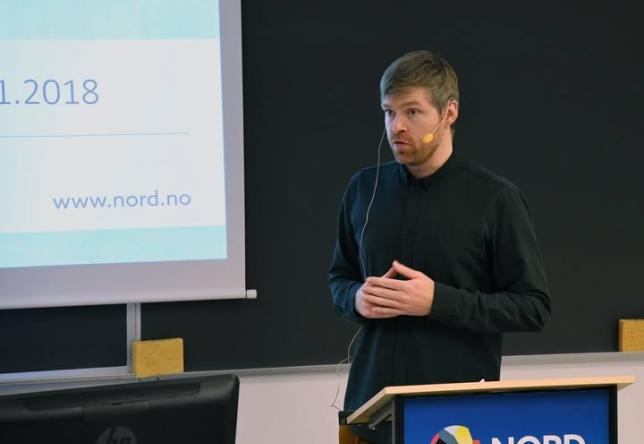
– Givende å se studentenes stolthet når de fullfører