

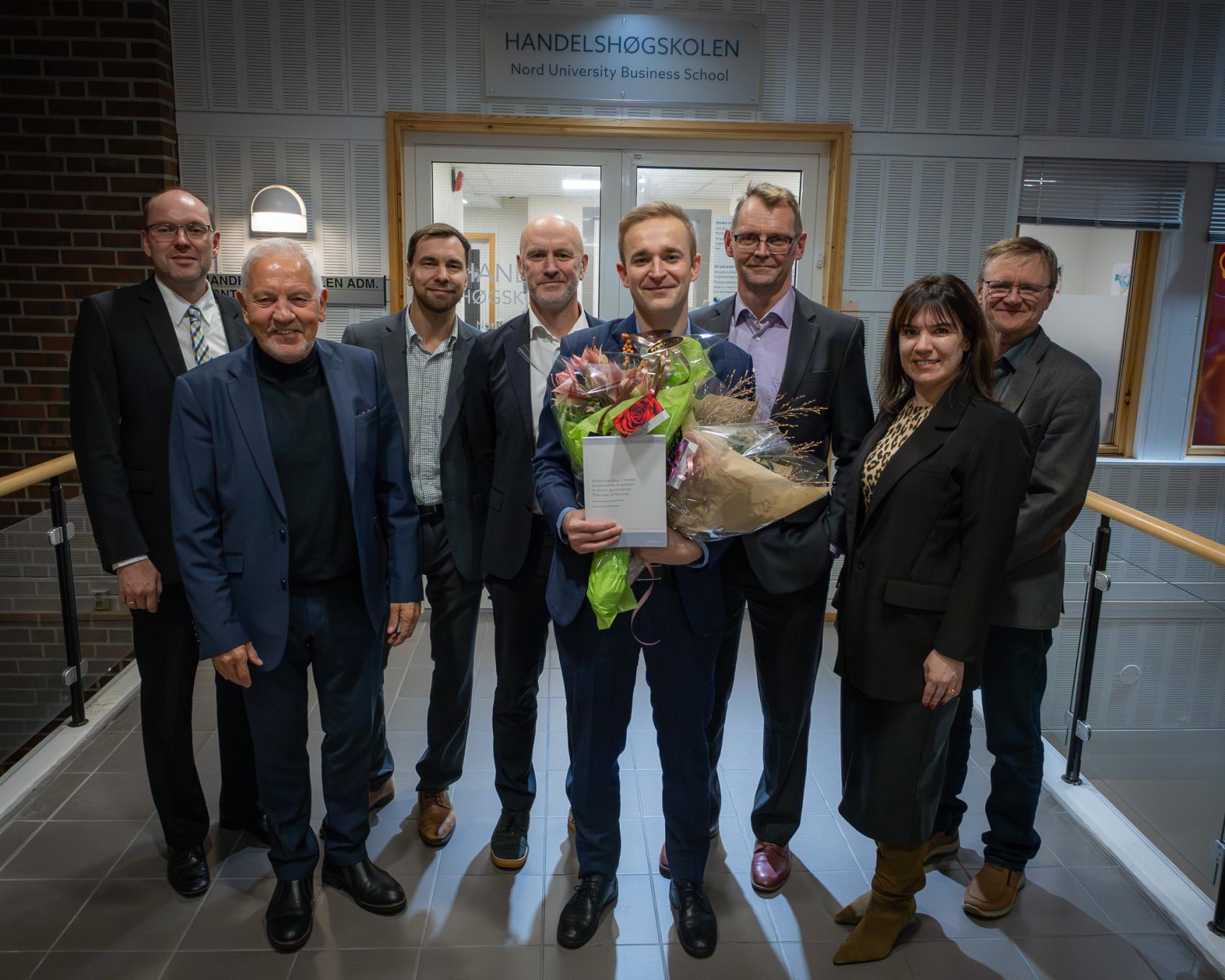
Anders Christoffer Edstrøm photographed by Inger E. Eftevand Orvin.
– I believe the pictures we paint would have greater value if we used more colors, says the researcher metaphorically when discussing the challenging balancing act between economic development and national security.
– That's perhaps the biggest surprise during the project period – how few colors and nuances are used when talking about China and Chinese investments and ownership interests in the Arctic.
Not just scary
When we ask Edstrøm for an example, he refers to a recently published story on NRK about foreign ownership by Chinese, Russian, and Iranian citizens. The story is based on a report from Tax Justice Norway.
− The story is presented as quite dark and scary. It says that 378 companies are controlled by Chinese citizens. As a reader, I would have liked to know how many of these companies are, for example, family-owned restaurants, he says.
Who are the owners?
The story also mentions that 10 companies work with critical infrastructure in Norway.
− Ownership in critical infrastructure will naturally matter greatly when we talk about security and foreign ownership, says Edstrøm.
However, nothing is said about whether these companies actually have significant activity. SICHUAN ROAD & BRIDGE (GROUP) CORPORATION LTD. NUF is probably one of these. The company hasn't done much in Norway since the bridges in Narvik and Nord-Trøndelag were built several years ago, he says, referring to public company information.
– These are details I believe are important when discussing the actual presence of Chinese ownership interests.
To Bodø by accident
But let's go back in time a bit. 13 years, to be exact. How did a young man from Skien end up in Bodø, with Arctic issues as his field of interest?
– It was an accident, says Edstrøm. Admittedly with a smile, since today he thanks his own typo in Samordna opptak (the national university admissions system) for the study place that led to a master's degree and now also a doctorate at Nord University Business School.
Energy management and energy security
Some call it life's coincidences. For Edstrøm, a friendship with a Ukrainian fellow student and subsequent visit to Kyiv led to an interest in the Russian language and a desire to better understand the cooperation that existed with Russia at the time.
We're now talking about the time before the war, and Edstrøm accepted an exchange semester in Moscow with energy management on the schedule. Then came the master's thesis, and at this point a new exchange program had been established at Nord University Business School, now with Shanghai as the destination.
Edstrøm applied and got a place. He chose to write his master's thesis on China's investments in Yamal LNG, examining how energy security was a driving force for China's investments in the project.
Not at any price
Edstrøm's main question in the dissertation is: "How does Norway handle Chinese investments in the Arctic?".
With the doctoral dissertation completed, he believes the room for opportunity is becoming smaller than we might think.
– Chinese companies don't invest at any price, nor in just any industry, he says.
Mutual interests too
He believes that Norway today monitors Chinese investment interests closely.
– It's important and right to be alert and responsible.
Edstrøm advocates taking a step back and making rational assessments of cooperation that could be beneficial for Norway. We mustn't let ourselves be too frightened and become hindered by narratives that cause us to miss out on development, he says.
Edstrøm calls for more knowledge about local value creation perspectives and how investments affect governance mechanisms.
– And we must also not forget that Norway has significant business interests in China too. That shows this is also about mutual interests, says Anders Christoffer Edstrøm.