

Recently, Nord University in Levanger welcomed eleven master's students in arts and crafts from the University of Cádiz. The collaboration is a result of the Sea-EU university alliance. Photo: Bjørnar Leknes
This article is more than one year old.
The distance from Cádiz in Spain to Levanger in Trøndelag is fairly long. Specifically, it's 4,100 kilometers by car.
However, after Nord University became a member of the European university alliance Sea-EU, the southern European regional capital suddenly seemed much closer.
The University of Cádiz is also a member of the alliance. And it didn't take long for Solveig Åsgard Bendiksen and her colleague Ninni Rotmo Olsen to recognize the great collaboration opportunities.
“When the news came that Nord University joined Sea-EU, we were already very focused on applying for external funding. Since Sea-EU requires collaboration with other universities in the alliance to support projects, we established contact early with the Arts and Crafts department at the University of Cádiz. Professor Yolanda Munos Rey immediately responded to our request for collaboration, as the themes of Science Materials and Arts were also her area of work. We traveled south last autumn with the project, and it was a perfect match”, says Åsgard Bendiksen.
Project HandyKids
The project, HandyKids, was launched in 2018 and aims to develop art pedagogical experiences and methods in workshops by facilitating sustainable materials and tools within the field of Arts and Crafts.
The project obviously also sparked enthusiasm in Southern Europe. By 2023, the University of Cádiz had become a partner. Recently, Nord University in Levanger hosted eleven master's students in Arts and Crafts from the teacher education programme in Cádiz for a week of various workshops at the Røstad campus in Levanger.
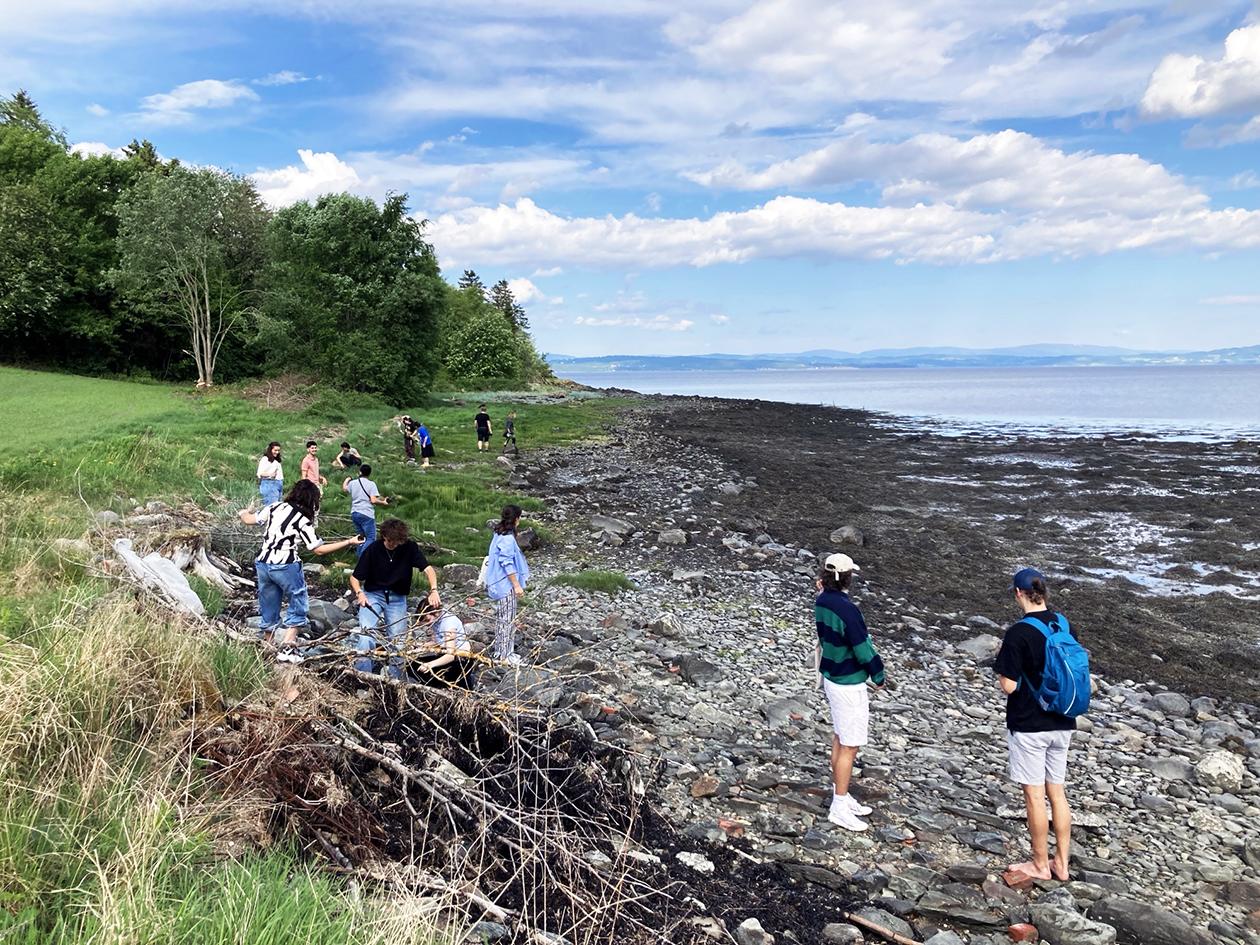
“Organizing workshops is always exciting because we don't know how they will be received. We have been working on the planning for a long time, and the feedback has been very positive. It has been simply overwhelming”, says Åsgard Bendiksen, who is responsible for HandyKids at Nord University together with colleagues Rune Hjelen and Ninni Rotmo Olsen.
22-year-old Ana Belén Mantell Pastoriza from Cádiz talks about an absolutely fantastic week, where she, among other things, explored sustainable methods within the graphic technique of intaglio printing.
“This week has been absolutely incredible. I am so grateful to be here and experience this. We have done so many exciting things, and it has been very educational”, she says.


Sustainability and wood fiber
The goal of the week, according to Åsgard Bendiksen, was to give the Spanish students a condensed version of how they ideally like to work with parts of the Arts and Crafts subject, focusing on sustainability and wood fiber.
“The keywords in our application were "Science materials" and "Art". Within science materials, we chose in this part of the HandyKids project to focus on wood fiber and composites, that is, materials composed of two or more different materials. We therefore established a practical collaboration with Norske Skog” says Åsgard Bendiksen.
Making something from scratch instead of buying it in the store, like paint from eggs or markers from candy, I think is very important for children today. Especially considering all the digital influences coming in. This is pushing out the old-fashioned woodworking part of the subject. We see this in the empty woodwork rooms and teachers lacking relevant education. So, the woodwork rooms are used for other things. How can we bring it back without excluding the digital?
Solveig Åsgard Bendiksen

"In another workshop, we focused on South Sami art and culture. The students experienced the dissemination of South Sami culture in a traditional Sami tent (gamma). They also tried their hand at creating their own duedtie, which is the Sami traditional handicraft and domestic industry. The students used materials such as wood, leather, and glass beads, guided by the Sami duedtie practitioners Margrethe Kristin Leine Biente and Tomas Tomasson Punde."

Alvaro: "HandyKids makes me a better teacher"
Alvaro Garcia Vázquez (23) also aims to become an arts and crafts teacher. He says he has greatly enjoyed his stay at Nord University in Levanger, and he is convinced that this week has provided experiences that will make him a better teacher.
“Yes, I absolutely believe so. In Spain, we are much more protective of students in school. Here, the methodology is completely different, and students get much more involved and learn by doing, not just by listening. It is a completely different way of teaching, which has inspired me”, he says.

Professor Yolanda Muñoz Rey at the University of Cádiz is also very pleased, both with the stay and the collaboration with Nord University.
“It has been absolutely fantastic. They have really prepared an incredible week full of educational workshops. Especially the connection between artistic education and nature has been interesting”, she says, adding that she also takes a lot of new knowledge back to Spain.
“It is always interesting to experience how differently teaching is practiced in different countries”, she says with a big smile.

Sees big potential for developing new Handy projects
Even though the HandyKids week is now over and the project is nearing its end, the research group behind it has a strong desire to continue.
“We have tons of data material that we need to analyse and write about”, says Åsgard Bendiksen.
“We are also invited by the University of Cádiz to be a partner in their research project, which focuses on sustainable fashion. Our wish is also to continue the fruitful collaboration with the South Sami duedtie practitioners in an even more intercultural direction”, she says.
Being creative is important for people throughout their lives, not least to stay active.
Solveig Åsgard Bendiksen
She adds that HandyKids has great potential in several directions.
“From the autumn of 2024 and for the next three years, anyone who wishes can explore their own "hands-on" experiences through our new and flexible study programme Sustainable Arts and Crafts. Here, the thinking, methods, and results from the HandyKids research project will be continued”, says Ninni Rotmo Olsen.
“We also see several other opportunities, such as "HandySenior". We have a large group of very competent retirees who have free time and are much more handy than we are”, says Solveig Åsgard Bendiksen.
“Being creative is important for people throughout their lives, not least to stay active. So, the potential is great, also in relation to health”, she says.


(This article is translated by Chat GPT and edited/quality assured by the Communications Unit at Nord University.)
Facts about HandyKids
HandyKids was established in 2018 by the Sustainable Arts and Crafts research group at the Faculty of Education and Arts in Levanger. In 2023, the University of Cádiz became a project partner.
The project aims to:
- Develop art pedagogic experiences and methods in workshops through affording sustainable materials and tools in the subject Arts and Crafts, in cooperation with students, pupils, and teachers.
- Design functional and sustainable workshops for students that represent physical, "hands-on" experiences direct in materials with tools.
- Explore science materials such as composites (bio-based, reuse/recycling) and renewable resources in different sustainable workshops.
- The research project leading to the HandyKids Week has been ongoing since 2018, including sub-projects where 5th graders, 9th, and 10th graders have participated in similar workshops. Arts and crafts students have participated in the planning, execution, and evaluation of their workshops.
Facts about Sea-EU
Sea-EU is a European university alliance for cross-border cooperation in education and research in Europe. The motto of the alliance is "Living sustainably by, from and with the sea."
The alliance consists of nine universities:
• Nord University (Norway)
• University of Gdansk (Poland)
• Kiel University (Germany)
• University of Western Brittany (France)
• University of Split (Croatia)
• Parthenope University of Naples (Italy)
• University of Algarve (Portugal)
• University of Cádiz (Spain)
• University of Malta (Malta)
Together, Sea-EU has more than 150,000 students and 18,000 employees. The universities in the alliance aim to strengthen the coastal research and education field and promote key areas of cooperation such as internationalisation, sustainability, digital transformation, openness and democracy.


Facts about HandyKids
HandyKids was established in 2018 by the Sustainable Arts and Crafts research group at the Faculty of Education and Arts in Levanger. In 2023, the University of Cádiz became a project partner.
The project aims to:
- Develop art pedagogic experiences and methods in workshops through affording sustainable materials and tools in the subject Arts and Crafts, in cooperation with students, pupils, and teachers.
- Design functional and sustainable workshops for students that represent physical, "hands-on" experiences direct in materials with tools.
- Explore science materials such as composites (bio-based, reuse/recycling) and renewable resources in different sustainable workshops.
- The research project leading to the HandyKids Week has been ongoing since 2018, including sub-projects where 5th graders, 9th, and 10th graders have participated in similar workshops. Arts and crafts students have participated in the planning, execution, and evaluation of their workshops.
Facts about Sea-EU
Sea-EU is a European university alliance for cross-border cooperation in education and research in Europe. The motto of the alliance is "Living sustainably by, from and with the sea."
The alliance consists of nine universities:
• Nord University (Norway)
• University of Gdansk (Poland)
• Kiel University (Germany)
• University of Western Brittany (France)
• University of Split (Croatia)
• Parthenope University of Naples (Italy)
• University of Algarve (Portugal)
• University of Cádiz (Spain)
• University of Malta (Malta)
Together, Sea-EU has more than 150,000 students and 18,000 employees. The universities in the alliance aim to strengthen the coastal research and education field and promote key areas of cooperation such as internationalisation, sustainability, digital transformation, openness and democracy.