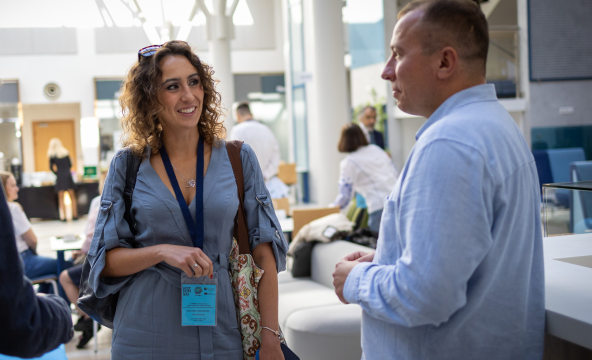


Project leader Ivana Bojanic (right) together with researcher and project collaborator Lise Tuset Gustad. They are now also searching for a PhD candidate to join the project. Photo: Bjørnar Leknes
Together with indigenous peoples in Norway, Sweden, and Greenland, researchers will develop a digital health tool that takes language and culture into account.
“This is an exciting project we received funding for from NordForsk in June, with a start date of October 1st. The project focus on developing digital health services and tools in collaboration between researchers and older Sami and Inuit elders” says project leader Ivana Bojanic.
In many Indigenous communities, health is understood holistically – as a balance between body, mind, family, culture, and community. This perspective often contrasts from the Western medical model, which typically breaks health down into individual components.
“When we create healthcare services or digital health tools for a population, it’s important that these are actually needed and wanted by that population. That’s why we will develop these digital health tools together with them,” explains project member Lise Gustad.
The project combines qualitative interviews, large-scale population surveys, and co-design. Elderly Sami and Inuit individuals will play a central role as active partners in the research.
“They are researchers along with us. We have a lot to learn from them,” says Bojanic.

A key goal is to contribute to more equitable health services. Today, there are several examples where Indigenous peoples receive lower-quality care, partly because language and culture are not always adequately considered.
“It can be something as simple as a sign or a brochure with the information in the correct language. Or that health personnel lack knowledge about how Sami and Inuit express symptoms. Context is crucial,” says Bojanic.
Gustad points out that the project can have effects beyond the target group:
“The knowledge we gain can benefit everyone. We know, for example, that mental health conditions increase the risk of heart disease. Still, we often treat the heart in isolation, without considering the whole of a person’s life. This project may contribute to a more holistic understanding in health care overall.”

Researchers at Nord University work closely with partners in Sweden, Denmark, and Greenland. The project builds on existing data from major Indigenous health surveys and will also generate new knowledge through interviews and participatory design.
“It was important to us that the users themselves – the elderly in Norway, Sweden, and Greenland – are involved throughout the process. That was probably one of the reasons the application received a top score,” says Gustad, who is also a specialist and research nurse at Levanger Hospital.
We know that mental health conditions increase the risk of heart disease. Still, we often treat the heart in isolation, without considering the whole of a person’s life.
Lise Tuset Gustad
“Equitable health services are also a prioritized goal for the Central Norway Regional Health Authority. I am pleased that the hospital trust will benefit early on from the knowledge we develop through this project,” she adds.
The project will last for four years and end with a prototype for a digital health tool—available in both Indigenous languages and Scandinavian languages.
“It can end up as a simple app or a digital platform. The point is that the tool will be developed by and for those who will actually use it,” says Bojanic.

The project has received NOK 15 million in support from NordForsk and marks the first time Nord University has succeeded in this competition.
“I had to read the letter several times when we received the answer. It was almost unbelievable. But the project is unique, and we strongly believe in it. The fact that we received seven out of seven points in the evaluation shows we are on the right track,” says Bojanic.
“We encourage everyone interested to apply for this PhD position,” says Bojanic.
For Nord University, the project also strengthens key focus areas in innovation, health, and welfare. A new PhD position has been advertised in connection with the project, and a Postdoctoral position is also announced at the University of Southern Denmark.
“Equitable health services are high on the agenda, whether in the healthcare system, politics, or research. I am glad we have succeeded with this project, and I look forward to seeing what we can achieve together,” says Gustad.
Project facts
Name: Promoting Healthy Aging of Sámi and Inuit Elders Through Co-Designed Digital Health Tool
Project leader: Ivana Bojanic, Nord University
Project period: 2025–2029
Funding: NOK 15 million from NordForsk
Partners: Researchers in Norway, Sweden, Denmark, and Greenland
Target Group: Elderly Sami and Inuit (65+)
Main goals:
- Promote sustainable health and quality of life
- Develop a digital health tool in Indigenous and Scandinavian languages
- Strengthen equitable health care services
More information about the project
More information about PhD position: Stipendiat innen nordisk urfolkshelse (285210) | Nord universitet


Project facts
Name: Promoting Healthy Aging of Sámi and Inuit Elders Through Co-Designed Digital Health Tool
Project leader: Ivana Bojanic, Nord University
Project period: 2025–2029
Funding: NOK 15 million from NordForsk
Partners: Researchers in Norway, Sweden, Denmark, and Greenland
Target Group: Elderly Sami and Inuit (65+)
Main goals:
- Promote sustainable health and quality of life
- Develop a digital health tool in Indigenous and Scandinavian languages
- Strengthen equitable health care services
More information about the project
More information about PhD position: Stipendiat innen nordisk urfolkshelse (285210) | Nord universitet